
Thought piece
How to Work Out Your Cap Table With Your University Before You Sign
The pools of shares set aside before investors arrive, the kinds of shares a university holds and any cheque that turns into shares later each change what founders keep. This guide takes them in the order the questions are best asked.
On this page
Faraz Rizvi is a UK operator-practitioner writing about the work between a research breakthrough and a fundable company. He runs SpinUp Forge, a single-operator practice that does a UK university spinout's company-building while the founders stay on the science. Foundry is SpinUp Forge's custom agentic harness.

Take a spinout where founders hold 80% and the university 20%. Three pools of shares are set aside, for an incoming chief executive, employees and a research funder, and the founders fall to 50% while the university keeps 20%. In this stylised case, published by Cambridge's University Commercialisation and Innovation (UCI) Policy Evidence Unit, the policy takes the pools from the founders alone. That is the harder, less common case: most approaches UCI surveyed share CEO and employee pools. The pools, and the cap table (who owns what), shape your stake, investors' due diligence (their checks) and what the university gets.
Whose stake the pools come out of
UCI's Busting myths and moving forward (2022) is an excellent, clear guide to a complex area, and its examples still hold. Policy and numbers have moved on. The government accepted the 2023 Independent Review of University Spin-out Companies, which backs market-terms deals and offers 10% to 25% university equity as a starting point for life sciences. Data published by the Royal Academy of Engineering (RAEng) puts average university licence stakes (shares for licensing the research) at 16% in 2025, down from 25% in 2023 (partial 2025 data; licence shares only).
UCI's 2022 survey of UK technology transfer offices (TTOs) found that who bears the CEO and employee pools varies between approaches, and that approaches where the university takes a smaller stake are more likely to take the pools from the founders alone. Employee options are rights for staff to buy shares later. A research funder can get a pool too: UCI says equity may be taken so that a non-public research funder, such as a medical charity, benefits from the commercialisation of the IP (the research and know-how licensed or transferred to the company) it helped to fund. According to UCI's survey, that pool usually comes out of the university alone (75% of university responses), though the example charges it to the founders.
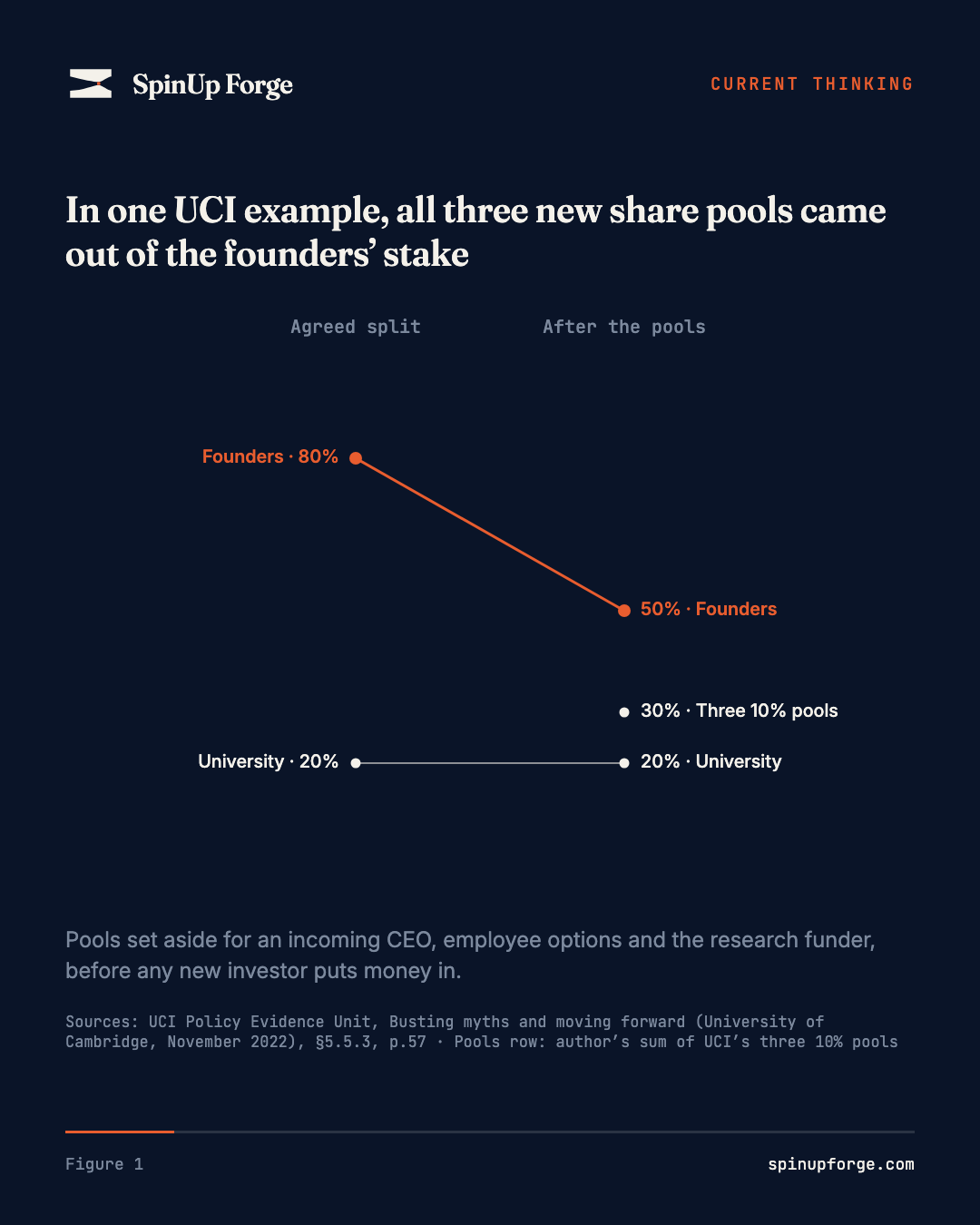
Table 1. The data behind Figure 1.
| Agreed split | After the pools | Source | |
|---|---|---|---|
| University | 20% | 20% | UCI 2022, p.57 |
| Founders | 80% | 50% | UCI 2022, p.57 |
| The three pools | none | 30% | My sum of UCI's three 10% pools |
Ask whether the pools can come out of both sides, whatever starting percentage you are offered.
The university's rights can lapse as its stake shrinks. UCI reports that universities may seek rights beyond shares, such as consent over decisions like taking on debt, information rights (the right to receive reports on the company) and pre-emption rights (a holder's right to buy into later funding rounds, where the company raises money from investors, to keep its own percentage); its examples are information rights lost below 5%, and a director's seat lost, or cut to an observer's seat (attending board meetings without a vote), below 5% to 10%.
If your university also invests
A university can hold its stake in two kinds of shares, and each does a different job. Licence shares are what it receives for licensing or transferring its research to the company, and for related support. Cash shares are what it receives for money it puts in. One university can hold both: RAEng gives the example, in an annex, of a University of Cambridge spinout where Cambridge Enterprise might hold the licence shares and the university its cash shares. I found no public source that records how often a university holds both.
A university-linked fund may also be a separate investor with its own holding and rights: the Independent Review describes such funds as private investment funds, though the university usually helps set them up and sits on the board. List it as a holding of its own.
Where the university invests on the same terms as other investors, its cash shares are ordinary investment, not a hidden cost. Like any investor's shares, they dilute you, meaning they shrink your percentage. In UCI's second illustrative case in the 2022 report, the university "invests cash on the same terms as investors". The Independent Review says such market-terms investments should be treated separately from licence equity.
If you are quoted the RAEng average university stake of 16% (the 2025 figure in Spotlight on Spinouts 2026, whose 2025 data RAEng marks as partial), know that it counts only licence shares and leaves out option pools and cash shares. Any comparison with your offer is approximate: because it leaves out option pools, RAEng's percentage is not the fully diluted share (every share, option and convertible that could become a share).
The cheque that converts later
Cash can arrive before any shares are issued. UCI says university investment funds typically invest for equity or through loans that convert to equity at a certain date. An advance subscription agreement (ASA) is another converting cheque: the company gets the money on signing and the shares come later. The law firm Ashfords describes what decides when the money turns into shares and at what price:
- Trigger (my label): the event that turns the money into shares. Ashfords lists an investment round, the longstop date, a sale of the company or an insolvency (the company cannot pay its debts).
- Longstop date: the date by which the shares are issued if no round has happened, which Ashfords says is usually six to twelve months after signing. If an investor in the round is claiming SEIS or EIS tax relief on the shares, HMRC's Venture Capital Schemes Manual says it expects the longstop to be no more than six months and that it is unlikely to give advance assurance beyond that, so the two time frames can pull apart.
- Discount: a lower price than later investors pay. At the 20% discount Ashfords reports often seeing, the cheque buys 25% more shares than at the round price (my arithmetic).
- Ceiling (a valuation cap): an agreed valuation of the company that sets the highest price the cheque converts at, even if a later round prices shares higher, so the cheque can buy more shares than at the round price.
An ASA defers issuing shares, so it is often seen as a way to avoid fixing a valuation. Ashfords says that is not really so, because many ASAs carry an agreed ceiling.
I operated an ASA and a convertible loan at my regulated payroll-and-pensions fintech. An ASA is a risk-bearing investment. It can be useful for a university that wants to get cash into a company without setting a price that might concern investors, and in exchange the company gets runway (time before the cash runs out) while it tries to close a round. The conversion terms are what a founder should pay attention to, not just the size of the cheque.
What an investor will find anyway
Investors will look at the cap table, the rights attached to each holding and any money committed to turn into shares. Orrick, a law firm, says most venture capital investors will insist on some form of legal due diligence, and Oxford University Innovation describes it as detailed questions that may take time. A university holding shown with its terms and the answers ready can take less of that time and raise fewer questions.
What the university wants, and why it helps you
UCI describes university investment funds as a way to draw in co-investment (other investors' money alongside) at pre-seed and seed, the earliest funding rounds. For you, that means a university that invests may help bring other investors into an early round alongside its own money.
What to ask before you sign
The founders and the university should agree together how these holdings are listed and shown. I would not confuse a university's cash holding or commitment with its licence shares: I would list them separately and show both to investors first, with the terms written down.
At your next meeting with the TTO, ask for written answers to these seven questions, before you sign.
- Which pools will exist at signing, how large is each, and whose shares does each come out of? Can they come out of both mine and the university's?
- At signing, which shares will the university, its TTO or a university-linked fund hold: licence shares, cash shares or both? Do any cash shares go in at the same price and terms as the other investors?
- When you quote me a percentage, is it measured the same way as RAEng's figure of 16%: with or without the pools, as of what date, and is it the fully diluted share?
- Is any money arriving or committed as a convertible loan or ASA, and does the percentage you quoted include the shares it would become? What are its trigger, discount, ceiling and longstop date, and how many shares would it turn into?
- Which rights does the university keep, at what holding does each end, and do licence and cash shares count together towards it?
- Does the university, or a university-linked fund, have an agreement giving it favourable access to invest in my company, and how would I be told?
- How will we present the university-side holdings to investors, and who puts them in the data room (the documents investors are given to check) first?
Sources
- RAEng, Spotlight on Spinouts 2026 (full report)
- RAEng, Spotlight on Spinouts 2026 (news release, 3 June 2026)
- UCI Policy Evidence Unit, Busting myths and moving forward (November 2022)
- UCI Policy Evidence Unit, Spinning out Success (2024)
- Independent Review of University Spin-out Companies (Tracey and Williamson, November 2023)
- GOV.UK, Independent review of university spin-out companies (publication page: the government accepted all the recommendations, response published 22 November 2023)
- Ashfords, What is an ASA (Advance Subscription Agreement)?
- HMRC, Venture Capital Schemes Manual, VCM12025 (advance subscription agreements; page updated 29 October 2026)
- Orrick, Founder Series: Top Tips for University Spin-Outs Part 1, Raising Funds (March 2024)
- Oxford University Innovation, Getting investment
Evidence note
- Sample and caveat: the 16% is RAEng's average non-cash stake for 2025, which RAEng reports as partial "due to both tracking reasons and regulatory filing still in progress". RAEng analysed 776 spinouts formed since 2015, after its exclusions.
- Method attribution: what the 16% counts is from RAEng's key methodological considerations. RAEng states that its percentage leaves out option pools and refers to the company's capitalisation table at the spinout agreement time, built from Companies House filings; it does not use the term fully diluted.
- Scenario A: I left UCI's scenario A out because its stated proportionate split does not reproduce its figures (pro rata, 35% and 65% would leave 24.5% and 45.5%, not 20% and 50%); scenario B is consistent. The pools row, 30%, is my sum: 100% less UCI's 20% and 50% (UCI 2022 report, p.57).
- Longstop and tax relief (added 9 November 2026): the six-month point comes from HMRC's manual page VCM12025, which describes it as what HMRC expects as a general rule; a longer longstop does not of itself make an investment ineligible, but HMRC says advance assurance is unlikely beyond six months. Ashfords' six-to-twelve-month range is its description of what is usual, not a tax rule.
- Author experience: the paragraph beginning "I operated an ASA" is my own experience.