Two Spinouts a Year Became Ten. The Fix Is on Page 79.
Buying in someone who has already built a company is ordinary practice at universities that can afford one alone. In January a review told the ones that cannot to share one, and it is the right first move for fewer of them than that sounds.
Faraz Rizvi is a UK operator-practitioner writing about the work between a research breakthrough and a fundable company. He runs SpinUp Forge, a single-operator practice that does a UK university spinout's company-building while the founders stay on the science. Foundry is SpinUp Forge's custom agentic harness.
A survey respondent inside Research England's evaluation of its shared technology-transfer pilot reached for a kitchen to explain what the work had actually bought their institution. The menu was settled, the equipment was in, the kitchen staff were trained. "What we need next," they wrote, "is the time to cook!" Months before that evaluation reached the public, a review for UKRI written by Tony Hickson had put the same point in drier language: universities with fewer spinouts and thinner budgets need people they cannot justify hiring alone, and the honest way to get them is to share. That recommendation exists. Almost nobody has acted on it since. Most of the universities it was written for have something else to fix first, and at the ones it does fit, nobody has settled which budget pays.
What actually happens after a disclosure
An academic discloses an invention to their university. Someone assesses whether it is worth protecting and whether a licence or a new company is the better route. If it is a spinout, someone negotiates the licence terms, agrees an equity structure, and walks the paperwork through incorporation. All of that sits inside what people call a technology-transfer office, or TTO.
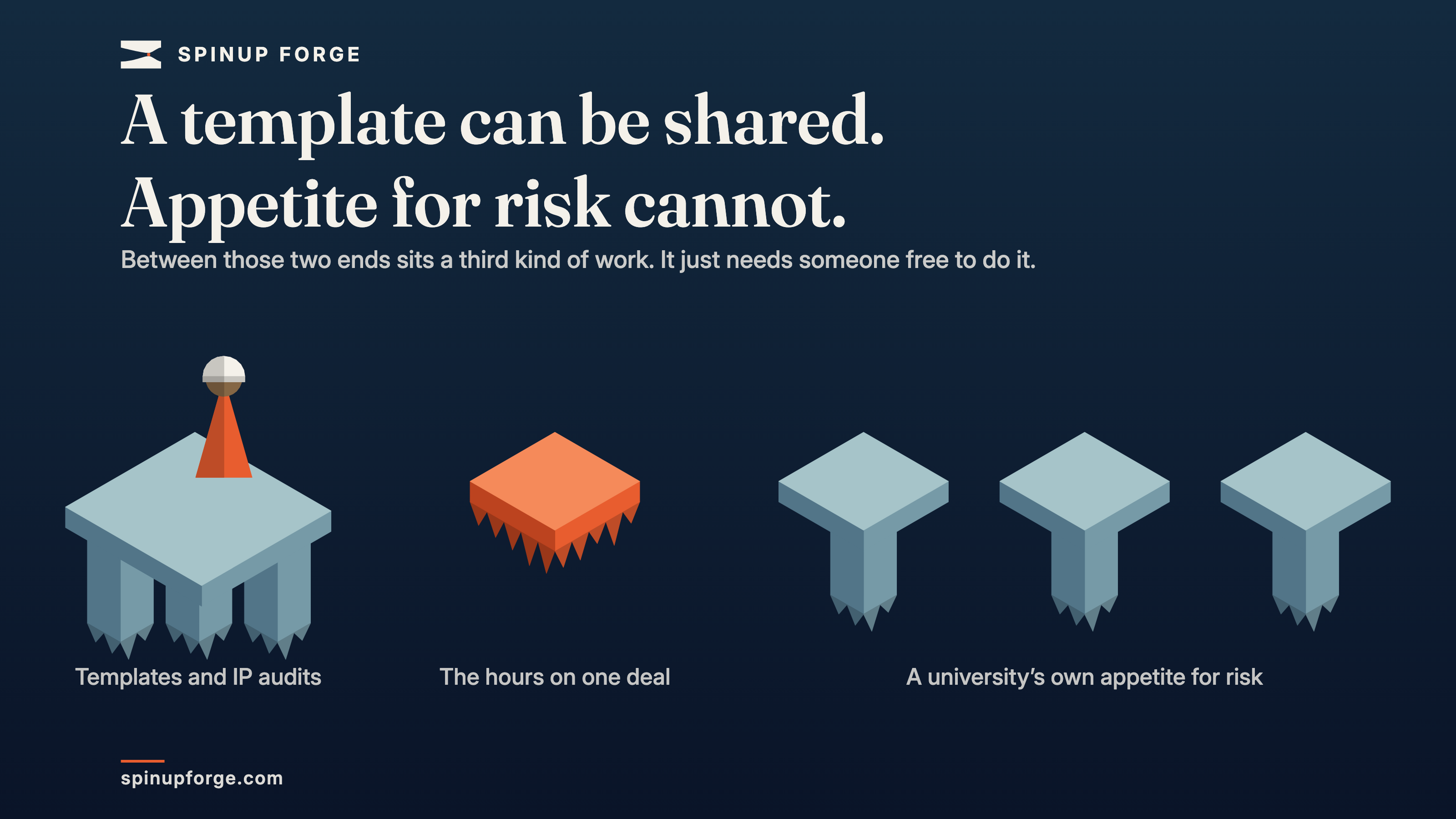
Some of that work is identical everywhere a disclosure lands, and universities can pool it without giving anything up. Research England's evaluation of its own pilot programme found exactly this: among the busiest shared activities across the thirteen pilots were "guidance and toolkits" and "jointly undertaken IP audits," the standardised, repeatable parts of the job. Shared decision-making and shared policy were the least-developed activity across the same pilots, and the evaluation is candid about why: that work reaches, in its own words, "into institutional resourcing and policies for technology transfer," and can raise "difficult questions around management, value and resources." A template can be shared. A university's own appetite for risk cannot.
Between those two ends sits a third kind of work, and the evaluation never gives it a name. Every disclosure needs it differently, which is what stops it being a template: the hours spent moving one specific case, one invention, one founder, from an assessed opportunity into something an investor can look at. Nobody's risk committee needs to sit for it. It just needs someone free to do it, the one part pooling and policy both leave alone.
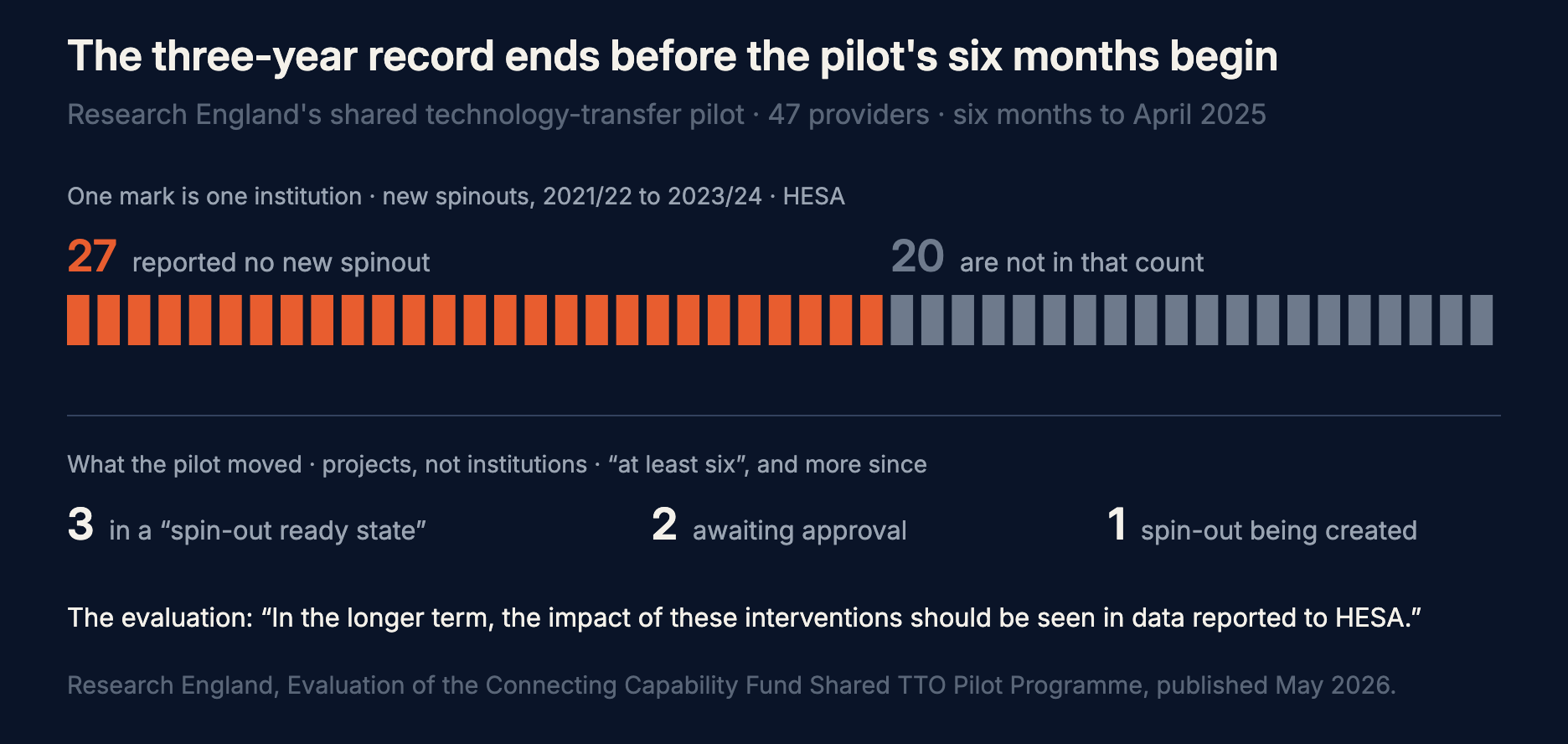
That distinction is what Research England spent £4.74 million testing, across thirteen university consortia and 47 higher-education providers, over six months. Judged on the one thing the funding Call actually asked for, spinning out companies from IP that already existed, not building a pipeline from nothing, the result is exact rather than dramatic: one company created, two deals awaiting approval, three more in what the evaluation calls a "spin-out ready state." That is not a verdict on whether pooling works. Company formation runs longer than six months everywhere; on this series' own reading of UKRI's data, it still runs to 11 months even once an investor has expressed interest. Six months bought the shareable part of the process, and a receipt for how far that part goes on its own.
The same six-month snapshot looks different next to Research England's own commercialisation report, reading a similar formation series: it calls the trend "an increasingly positive trajectory" rather than a crisis. The honest complaint is distribution, not volume.
Who has the backlog
Cranfield University and the University of Hertfordshire ran one of the thirteen pilots between them, under the name STREAMLINE. The evaluation describes both as having "very small TTO teams (two FTE each) managing substantial IP pipelines": two full-time posts at each institution, against everything their academics had disclosed. Their own case study names the shortage: "Problem was not lack of pipeline but lack of resource to process and progress disclosures to the next stage." That is the shape the fix is built for. A backlog, and nobody free to work it.
Most of the cohort had no such record. 27 of the pilot's 47 participating providers reported no new spinout at all across the three years to 2023/24, in the evaluation's own footnote, citing HESA. Pooling the standardised part of the job only helps an office that already has a queue to run it against, and the report carries one direct observation about what the pilots found when they went looking for cases to move. A lead university's own monitoring return, quoted in the evaluation, records "fewer later stage projects than anticipated in the HEP pipelines." One line, from one project, and it does not point where the policy assumed.
Asked whether these thinner institutions can sustain a shared service or whether the pipeline itself is too small, the evaluation declines to answer: "the data to inform this is simply not yet available." I am not going to answer it either. What survives the refusal is smaller, and it holds: these are two different problems sitting in one cohort, and an office cannot reliably tell from the inside which of them it has, because a full week feels the same either way.
So there are two readers here, and the recommendation only answers one of them. For an institution whose disclosure book is genuinely thin, it is aimed past the problem, and the honest first step is finding out what the institution actually holds before asking who should share it. For an institution shaped like Cranfield and Hertfordshire, a real backlog and a named person missing, it is the right answer.
The one place it is already running
For a university with a backlog, Hickson's review names the fix twice: once as recommendation one, in the chapter on capacity and place, and one chapter earlier, on page 79, in plainer language, describing universities with "limited resources, such as many post-92 institutions" and naming the remedy directly, "hiring fractional positions or sharing such roles" across a regional group. Two different routes, the same reviewer, the same answer.
The fix already has a working example. Six universities in the North East, Durham, Newcastle, Northumbria, Sunderland, Teesside and York, have been running a version of it for the better part of a decade, under the name Northern Accelerator, alongside Durham County Council and the North East Combined Authority. It runs a version of what the same chapter, describing the model generically a few paragraphs earlier, calls an entrepreneur in residence: someone who has already built and sold a company, paid for six months to a year, working a region's early-stage ideas rather than any single university's own pipeline. The review's own account of the result: an uptick from "producing two spin-outs/year" eight years ago, "to now producing 10 a year."
Buying in an experienced operator is not, by itself, an unusual idea. The evaluation says so plainly: "There is an active market for support services in spin-out and technology transfer." Hickson's review gives entrepreneurs in residence a section of its own, and universities with the budget to hire one have been doing it for years. The review asks for something narrower and harder: several thin-resourced universities buying the same person between them, regionally, because sharing is the only way any of them can justify the post. That is what the North East built. Which leaves the question. Among the universities that do have a queue, why has almost nobody else built one?
One of the thirteen has since formalised it. On 29 June the University of Portsmouth announced a Shared Virtual Technology Transfer Office with Southampton Solent, Chichester, Health Sciences University, Arts University Bournemouth and Winchester. Portsmouth led the Wessex pilot, and four of those six, Portsmouth among them, are named in its project record, so this is not a new region reading the recommendation and acting on it. Portsmouth's own announcement says as much: the partnership "builds on a successful pilot project funded by UK Research and Innovation". It is the group that already did the work, deciding to carry on doing it.
Which makes what they chose to pool worth reading closely. The announcement describes expertise, resources and networks. It does not mention a shared person. An announcement is not a staffing plan, so the silence proves nothing on its own. But these are the people who have actually run the experiment, and the layer they formalised is the one the evaluation had already shown works.
So why not the person as well? Not for want of money, in any simple sense. The same review's chapter on finance separately calls for the UK to "Significantly boost funding for pre-incorporation" and pre-seed funding, cash before a company exists, which is a different stage from the pre-seed and seed money this series has already reported climbing into spinouts that already exist. And what money there is arrives unevenly: formation itself, Hickson notes, is spread across the whole UK, while investment stays "concentrated in the Greater South East." Northern Accelerator's own answer to that was to stop waiting for the aggregate to reach it. Hickson's review also records that the same North East partnership has, only recently, built its own £22.5 million seed fund, arriving alongside eight years of shared operator time rather than in place of it, on the reading of the dates. Whatever produced the climb from two to ten was money and people, from different pots, at different times.
Money is not the whole of it, then. A university's own appetite for risk moves slower than money does, and it cannot be pooled. Underneath even that sits something smaller and older than the review: a line on a form that nobody has decided how to fill in.
Which budget line pays for it
Somewhere between now and the next commercialisation bid, at a university that does have the queue, a paper like this crosses a Pro-Vice-Chancellor's desk: hire someone, fractional, paid for six months to a year, to move assessed opportunities into companies. Follow what happens to it.
Charge it to HEIF, the formula-allocated core budget that already pays most of a TTO's own salaries, in a period the evaluation itself describes as one of "redundancies in both academic and professional services teams" at some of the very institutions it studied, and a TTO director reads the request correctly: as a claim on the same money their own headcount sits in. Charge the identical person, doing the identical work, to project or regional money instead, the kind that funded all thirteen pilots at award values of £158,000 to £500,000, per Research England's evaluation, and the same request reads as something that arrives, does a job, and leaves without touching the base budget. Same person. Same six months. A different verdict, before anyone in the room has said a word about whether the argument itself is any good.
I have spent a few years on the institutional side of exactly this kind of conversation, and I have not seen the pattern break yet: the account decides the reading before the argument gets a hearing.
Call the person operator capacity and the phrase names a capability the TTO already claims to hold on its own books, so the request reads as competition for it, and routes, on reflex, to the core budget the TTO's own salaries already sit in. Name the stage instead of the capability, post-approval company formation, or pre-seed venture building, and the identical request reads as a different job, with its own funding line and its own committee.
| Where the money is charged | How a TTO reads the request |
|---|---|
| HEIF core allocation | Competes with the TTO's own headcount |
| Project or regional grant | Additive: arrives, does a job, leaves |
| The company's own cap table | Additive, once dilution and conflict terms are agreed |
Hickson's review uses the broader name, and so does almost everything written in support of it.
The survey respondent who reached for a kitchen was not asking for more equipment. They had the menu, the room, the trained staff. What they wanted was somebody at the stove and an account to pay them from. Who to hire has had a written answer since January. Which account pays has not been asked in the rooms where it applies, and in a good many of the others the kitchen is not built yet.
Sources
- Research England, Evaluation of the Connecting Capability Fund Shared Technology Transfer Office Pilot Programme (produced November 2025, published May 2026)
- UKRI / Research England, Deepening University-Investor Links, a review by Tony Hickson (dated 28 January 2026, published February 2026)
- Research England, Driving Growth: a focus on England's universities' intellectual property and commercialisation landscape 2023-24 (published January 2026)
- Ulrichsen, T. C. and Miller, J., Powering Ideas to Innovation, UCI Policy Evidence Unit, Institute for Manufacturing, University of Cambridge (June 2025), re-verified against the primary for this run
Evidence note
- The cooking quotation. "If I might use a cooking analogy, this pilot project has enabled us to settle on a menu, ensure we have all the equipment and utensils we need, ensure the kitchen staff are fully trained up and even do some of the food prep. What we need next is the time to cook!" — a survey response from an HE partner, quoted in Research England's evaluation, p.39.
- What pools and what doesn't. The mechanisms/expertise/governance taxonomy and the top four areas of activity ("jointly developed and delivered training," "guidance and toolkits," "supporting early-stage ideas," "jointly undertaken IP audits or gap analysis") are on p.4 of the evaluation. Why governance lagged is on p.18: "There was less activity focused on governance... These are inherently more difficult to develop and establish as they reach further into institutional resourcing and policies for technology transfer." The source's subject there is "they" (governance activities); the body renders it as "that work... can raise" for grammatical fit, leaving both quoted fragments unmodified.
- £4.74 million / 81 organisations / 47 HEPs / 13 pilots. "A total of £4.74m Research England funds were awarded... Individual pilot project award values ranged from £158k to £500k," and "A total of 81 unique organisations were involved in the pilot projects, including 47 HEPs and 4 RPOs," per the evaluation, p.12. The Call ran over six months in 2024-25.
- The outcome count. "One spin-out being created, two awaiting approval, and three in a 'spin-out ready state'" is the evaluation's own figure (p.27), set against a Call scoped (Appendix A, p.49) as an "exclusive focus on spinning out companies" built "based on university-generated IP" and explicitly excluding "general knowledge exchange or pipeline creation."
- The eleven-month figure is not re-verified here. It is cited from this series' own "The Equity Debate Took Three Years. The Formation Clock Has Not Moved.", sourced there to UKRI's analysis of the Hickson review evidence base: average time from investor interest to formation for a deep-tech spinout.
- The positive-trajectory counter-read. "In 2023-24, the number of newly registered spinouts decreased by 3.5% (five spinouts)... the longer-term trend over the ten-year period from 2014-15 to 2023-24 shows growth of 17.4%, rising from 115 to 135 spinouts. This suggests an increasingly positive trajectory," per Research England's Driving Growth, p.29. England-only, running to 2023-24, and so not directly comparable to the UK-wide formation counts this series has used elsewhere. That scope limit is why it is not pressed past the one sentence in the body.
- STREAMLINE. Cranfield University and the University of Hertfordshire, Case Study 1 (p.10), award £282,542 (Appendix B, p.53): "Two institutions with small TT resource (2 FTE at each)... Problem was not lack of pipeline but lack of resource to process and progress disclosures to the next stage." The body's "very small TTO teams (two FTE each) managing substantial IP pipelines" is the Appendix B description of the same partnership, which is where the evaluation states staffing and pipeline in one clause. "Two full-time posts at each institution" restates that figure; it is not a second source. Note the evaluation's own glossary defines FTE as workload rather than headcount, so 2 FTE need not mean two people.
- The thinner-pipeline observation. "There were fewer later stage projects than anticipated in the HEP pipelines" is one lead HEP's monitoring return, quoted in the evaluation, p.32. One project's report, not a cohort finding, and the body says so. It is the only direct in-document observation of what the pilots found when they looked for cases at the formation end, and it runs against the argument the piece is otherwise making, which is why it sits in the body rather than here.
- The Wessex Shared Virtual TTO, and what it is not. Announced on 29 June 2026, per the University of Portsmouth's own announcement. Portsmouth led one of the thirteen pilots, an award of £487,664 for "Bridging the Gap: A Shared Technology Transfer Office Vision for Wessex" (Appendix B); Portsmouth, Southampton Solent, Chichester and Arts University Bournemouth are named in that project record, and Portsmouth's announcement states the partnership "builds on a successful pilot project funded by UK Research and Innovation (UKRI)". Health Sciences University appears to be AECC University College renamed, which would make it five of the six, but that rename is not confirmed from a primary here, so the body claims only four. Winchester is the one genuinely new name.
- The 27-of-47 figure. "27 of the participating HEPs reported no new spin-outs in the 3-year period 2021/22 to 2023/24, and 7 participating HEPs reported research incomes of under £1.5m in 2023/24. Source: HESA," per the evaluation, footnote 10, p.43. The research-income detail is not carried in the body. HESA's own HE-BCI pages could not be read directly for this piece, so the figure comes from the evaluation's restatement of the HESA data rather than from HESA.
- The sustainability question. The evaluation records being asked whether these institutions are "capable of keeping a shared TTO facility running or is the pipeline too small" (p.42), and answers that "the data to inform this is simply not yet available."
- Recommendations one and two. Hickson review, chapter 6, "Capacity, capability and place" (p.96): "Address talent gaps in leadership and expand infrastructure access for spin-outs," with the sub-point that "UKRI should monitor and scale regional initiatives such as Northern Triangle Talent," aimed at "leadership bottlenecks in spin-outs outside the Greater South East"; and "Enable models for sector-based shared technology transfer offices."
- The fractional-roles passage. Chapter 5, "Investor interactions" (p.79), in the section immediately preceding "Pooling deal flow": universities with "limited resources, such as many post-92 institutions" should consider "hiring fractional positions or sharing such roles" through regional collaboration.
- Pre-incorporation funding is a different stage. Hickson asks the UK to "Significantly boost funding for pre-incorporation" and pre-seed funding (p.12; restated p.10 and p.50). That is money before a company exists — proof-of-concept and translational funding — and it is a different stage from the pre-seed and seed investment into already-formed spinouts this series measured in "The Seed Money Arrived. The Bridge Didn't." (around £100 million in 2019 rising to £193 million in 2024, per UCI). Both are true about different points on the timeline; there is no contradiction between them.
- The Greater South East concentration line. p.84, at the head of chapter 6: "While the creation of spin-outs is geographically widespread, investment remains disproportionately concentrated in the Greater South East. This imbalance highlights the need to better connect regional innovation with capital." This is a different line from the p.96 one about "leadership bottlenecks in spin-outs outside the Greater South East": that one is about talent, this one is about capital.
- Northern Accelerator. Hickson review, p.74. The entrepreneur-in-residence model described a few paragraphs before Northern Accelerator is named brings in "a seasoned and accomplished business founder who typically takes a short-term role for 6-12 months"; the review does not tie that description to Northern Accelerator by name, and the body says so. Northern Accelerator's own uplift is "an uptick from producing two spin-outs/year (eight years ago), to now producing 10 a year." Six universities: Durham, Newcastle, Northumbria, Sunderland, Teesside and York, with Durham County Council and the North East Combined Authority.
- The Inspire fund. The Northeast Universities Spin Out Fund, developed through the Northern Accelerator programme, brings the North East Combined Authority's £10 million alongside £12.5 million from five of the six universities: a £22.5 million seed fund over five years, per Hickson, p.41. Described there as "the new" fund, which is the basis for the body's "only recently". The review gives no exact launch date to weigh against the eight-year uplift figure, so no more precise timing claim is made.
- Redundancies and award values. "Some participating institutions were experiencing redundancies in both academic and professional services teams, alongside recruitment freezes and other limitations on spending," per the evaluation, p.21. Individual pilot awards ranged from £158,000 to £500,000 (p.12, stated there as £158k to £500k).
- First-person attestation. The passage on institutional budget dynamics draws on the author's role as Impact Acceleration Manager, Faculty of Engineering and Physical Sciences, University of Surrey, from January 2020. It is a general vantage claim from lived institutional experience, not a citation to a specific document or committee paper, and it does not substitute for the sourced claims around it.
- Method and caveats. Every source above is attributed by title, publisher and date. This piece does not use the evaluation's 323-opportunities or 854-attendees figures: the evaluation itself describes the 323 as a heterogeneous mix of "pre-spin-out assessments, innovation disclosures progressing, the validation of propositions, business case development, opportunities advancing in the pipeline and the matching of projects with venture managers," which is an activity count rather than a company pipeline, and neither figure is needed for the argument here.