
Thought piece
Planned Regulatory Sandbox Powers Have No Published Entry Bar, and Readiness Takes Operational Discipline
On this page
Faraz Rizvi is a UK operator-practitioner writing about the work between a research breakthrough and a fundable company. He took a fintech startup through the FCA regulatory sandbox in 2017, and now runs SpinUp Forge, a single-operator practice that does a UK university spinout's company-building while the founders stay on the science. Foundry is SpinUp Forge's custom agentic harness.
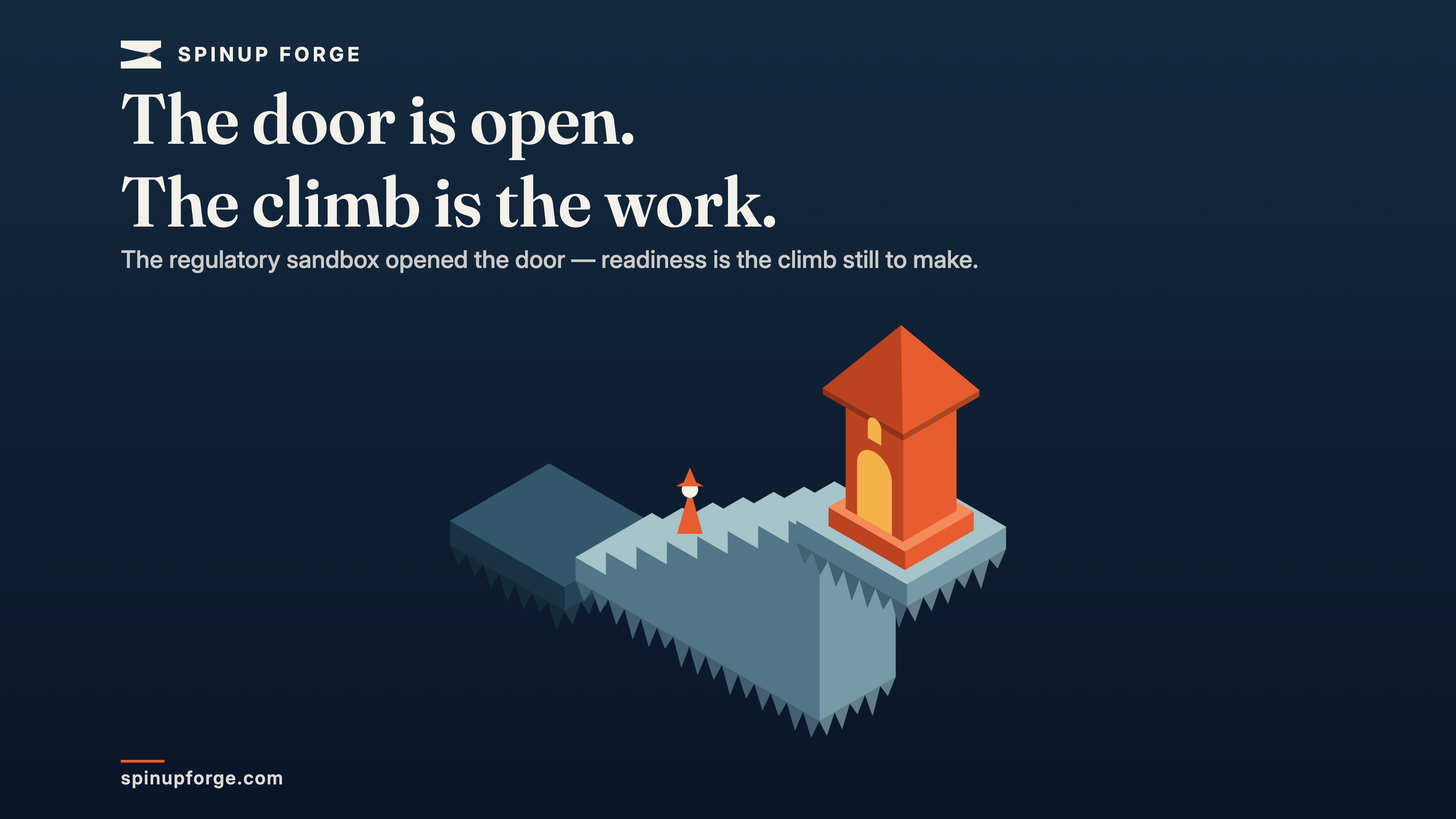
For a deep-tech academic founder in life sciences, AI-enabled medical devices or autonomous systems, regulatory deployment is the hardest obstacle in the commercialisation sequence. On 8 July 2026 the Regulating for Growth Bill named it, and it has just been assigned a mechanism: the government set out the details of the Bill's statutory sandbox powers that day (gov.uk, 8 July 2026). This series has named and traced the binding constraints in the UK spinout sequence: IP and equity terms, capital access, the VC bridge, skills and capability selection, and now regulatory deployment, the fifth. The mechanism comes with no published account yet of what readiness for it requires, or of whether the founders who need it are ready to use it.
The government plans sandbox powers but has set no entry bar
The Bill was announced in the King's Speech on 13 May 2026 and set out in more detail on 8 July. It would create cross-economy statutory sandboxing powers: existing rules can be temporarily modified or disapplied for controlled, live-market trials, and successful trials are fast-tracked to permanent embedding (King's Speech 2026 background briefing notes). The powers are aimed squarely at the sectors where regulatory deployment is the hardest obstacle a prototype-stage spinout hits: the priority sectors named by the government are AI, life sciences, autonomous maritime technology, and next-generation delivery services (gov.uk, 8 July 2026).
The Bill has not yet been introduced to Parliament, and no clause-level text is published. What exists is the statutory intent and the sector list. For a founder six to eighteen months post-licence, with a working prototype and a first institutional funder in view, that intent matters, and so does the absence of any information on how to prepare for it.
A trial leaves the record funders will ask for
The sandbox's value is the trial record it forces into existence: a bounded, evidenced record made up of a safety case, operating procedures, and a documented account of how the product was built and tested under scrutiny. For a deep-tech founder, those artefacts are the exact inputs to every serious institutional funding conversation they will have in the next twenty-four months.
Even Long Finance, which calls a general sandbox power "overdue," cautions that it "won't help with the complexity problem" and "could well exacerbate it" (Long Finance, 2026). This is undoubtedly correct: the sandbox will not lighten a deep-tech spinout's regulatory load, though for a founder the complexity critique is not the test that matters.
The FCA sandbox makes founders prove readiness first
The nearest published analogue is the FCA's regulatory sandbox, which makes founders prove readiness before they enter: a tested model, researched rules and an operating plan they can articulate. Entry requires meeting five criteria: the activity must be in scope, be a genuine innovation, demonstrate consumer benefit, show a need for sandbox support, and evidence readiness. Readiness is the criterion that catches deep-tech founders. The applicant must have thought through how the model works, researched the applicable rules, and be able to explain how the business will operate (FCA, regulatory sandbox eligibility criteria). The FCA expects a documented testing plan, covering scope, duration, number of users and success criteria, alongside a risk-control framework and a statement of how the firm will manage its obligations during the trial, and that makes evidencing readiness more than a formality.
For a fintech, that bar is achievable in months, though not trivially. In late 2016 I took my fintech startup through the FCA sandbox. From starting the readiness work to acceptance in June 2017 took about six months, and most of it went on diligently documenting the model, the rules and the operating plan before acceptance, not after. Even at that comparatively light end, readiness was the real work. For a medical-device or autonomous-systems spinout the bar is heavier still: a safety case, trial operating procedures, a human-factors assessment, and an evidence trail for how the product was designed and validated. None of it is produced in a weekend, or even over a summer. That evidence is the output of operational discipline running from the start, and in most spinouts at the six-to-eighteen-month mark that discipline simply has not been running.
The planned statutory sandboxes publish no such bar yet. The government's announcement describes the sandbox powers and the fast-track to permanent embedding, and leaves open the harder question of what a founder must have in place before any of this is usable. It says nothing about what a founder in autonomous maritime systems or AI-enabled diagnostics must have built, documented or demonstrated before an application is viable.
Readiness comes from how the company is run from the start
The support around founders keeps growing, and includes accelerators, venture builders and translation funding; none of it can hand a founder the operational readiness that sandbox entry depends on. A founder gets from a working prototype to the documented evidence sandbox entry requires through the decisions they make, or fail to make, about how the company is run before it is even a company. A spinout at month twelve that has logged every design decision, kept a version-controlled record of its testing protocols, and can hand over a two-page description of its operating procedures has already done its preparation, without needing the sandbox to tell it what to prepare. A spinout that has skipped this work is already behind a bar it does not yet know exists.
Start with a two-page description of how you operate
The diagnostic for a founder over the next ninety days is "can I describe my operating procedures in two pages." If yes, the readiness work is done and, in principle, the application is a matter of timing, though no entry bar has been published to test it against. If no, the work is operational, not political, and no amount of policy advocacy will get a founder from a working prototype to that documented evidence faster than the founder doing the work themselves.
Sources
- gov.uk — UK to become world's fastest market to commercialise innovation with regulatory shake-up (8 July 2026)
- King's Speech 2026 background briefing notes (13 May 2026)
- Long Finance — The Regulating for Growth Bill (2026)
- Pinsent Masons — Sandboxes central to Regulating for Growth plans (2026)
- FCA — Regulatory sandbox eligibility criteria
- UK Parliament Bills API, search for "Regulating for Growth" (19 November 2026)
Evidence note
- Bill status: as of 19 November 2026, Parliament's Bills database lists no Regulating for Growth Bill, and the government's 8 July 2026 release gives no introduction date and no application criteria (UK Parliament Bills API; gov.uk).
- FCA sandbox: the FCA ran seven numbered cohorts before moving to an always-open sandbox in August 2021, and has since run themed cohorts. The readiness wording above paraphrases the questions on the FCA's eligibility page.
- The author's sandbox experience: first-person. The author co-founded, and was COO of, a regulated payroll-and-pensions fintech admitted in the FCA's second sandbox cohort in mid-2017, about six months after the readiness work began. The company is named on the author's LinkedIn profile; this is not a publicly sourced claim.
- Constraint sequence: the five-constraint framing comes from the SpinUp Forge thinking series (spinupforge.com/thinking).