
Thought piece
University Equity Fell, but Spinout Formation Takes Eleven Months on Average
On this page
Faraz Rizvi is a UK operator-practitioner writing about the work between a research breakthrough and a fundable company. He runs SpinUp Forge, a single-operator practice that does a UK university spinout's company-building while the founders stay on the science. Foundry is SpinUp Forge's custom agentic harness.
Forming a UK university spinout takes 11 months on average, from the day founders and the university agree to spin out to signed agreements; the most common answer was four to six months. The figure comes from the founder survey for the 2023 Independent Review of University Spin-out Companies (annex D, November 2023), and UKRI's 2026 Hickson review repeats it (UKRI, February 2026). The equity debate that preceded the Hickson review took three years and moved the number it set out to move, university equity, and it did not move the formation clock.
Once you and your university have agreed to spin out, that clock is running; acting alone, you probably cannot shorten it, and it is the constraint that will shape your next year. The equity on the term sheet may be excellent, and the company will still be eleven months away. The real work is in what you do inside that window and in understanding why the window exists.
Formation takes about twice as long as a seed round
The eleven months is the average of the formation times founders reported in that survey, timed from when founders and the university or its technology transfer office (TTO), the unit inside a university that turns research into licences and companies, agreed to spin out.
The wider founder data is consistent with it. The spinout.fyi founder survey finds that 56% of spinout deals take more than six months to complete and 22% take longer than twelve. A UK seed round, by comparison, typically takes four to six months from first serious investor contact to close. Secondary figures from these surveys are in the Evidence note below.
| Series | Value | Source |
|---|---|---|
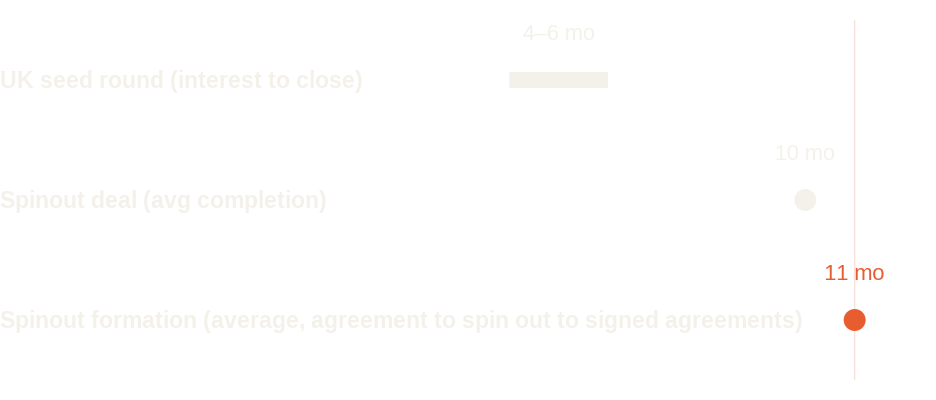
| UK seed round (interest to close) | 4–6 months | rsvrtech |
| Spinout deal (avg completion) | ~10 months | spinout.fyi |
| Spinout formation (average, agreement to spin out to signed agreements) | 11 months | 2023 Independent Review survey, repeated in the Hickson review |
Formation runs roughly double a UK seed round, and the equity reform did not touch it. Rendered figure: fig1-formation-clock.svg; full provenance: fig1-formation-clock.provenance.md.
Equity changed because it was one number to aim at
The equity reform succeeded while the formation clock stayed put because equity is a number you can target. Average university equity fell to 16%, a decade low, confirmed by the Royal Academy of Engineering's June 2026 data (RAEng, Spotlight on Spinouts 2026). Universities could adopt the USIT/Tracey guidelines independently, and progress was measurable in a spreadsheet.
A percentage is easy to read in a way that eleven months of sequential steps are not. Formation time is harder to reform because its bottleneck is a sequence of institutional steps rather than a single negotiable number: committee cycles that meet monthly at best, IP assignment requiring legal review on both sides, licence schedules needing UKRI clearance against underlying grant agreements, and founder sign-off on incorporation documents. Each step is defensible in isolation, and together they add up to eleven months. The Hickson Review's call for a national task force acknowledges this implicitly: no single institution can shorten the total on its own, because the total is produced by several institutions, each acting within its own governance constraints.
A long wait puts the investor and the team at risk
For a founder who has secured investor interest, the question is what happens to the investor relationship, the team's momentum and the company's competitive position during the eleven months the process takes. Whether the process can be compressed is a separate question.
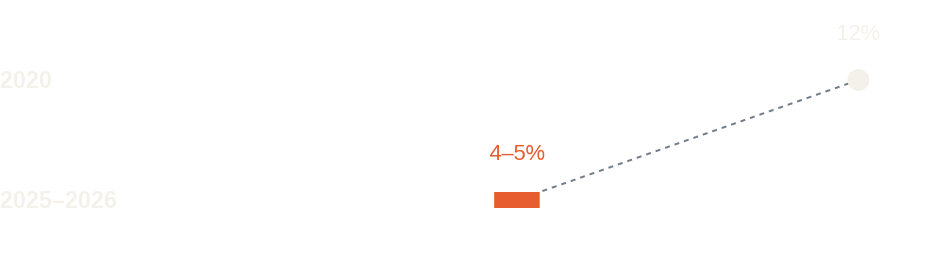
UK seed-to-Series-A conversion has fallen from approximately 12% in 2020 to roughly 4–5% by 2025–2026, according to NavigateVC's analysis of the UK market. These are figures for all UK tech, not spinout-specific, and spinouts have historically out-converted general tech (see the Evidence note), so read the 4–5% as the trend in the wider UK tech market that a long formation leaves the spinout exposed to, rather than as the spinout's own odds. An investor who expressed interest in a spinout at month one will re-evaluate that interest at month six, month nine and month eleven. The company they were interested in had a specific team, a specific IP position and a specific market window, and none of those is static.
| Period | Conversion | Source |
|---|---|---|
| 2020 | ~12% | NavigateVC |
| 2025–2026 | 4–5% | NavigateVC |
Conversion to Series A more than halved in five years. These figures are for all UK tech startups, not spinout-specific. Rendered figure: fig2-conversion-decline.svg; full provenance: fig2-conversion-decline.provenance.md.
Through the formation period, the founding team carries full operational risk with no legal entity to absorb it: no bank account, no ability to sign contracts, no payroll and no formal governance, while the institutions' own processes set the calendar. The TTO manages IP and fields investor queries, but nobody is running the company, and there is no company.
The Hickson Review's full report makes early investor involvement, before formal formation begins, an explicit recommendation, precisely because the window is long enough to lose investor conviction if the relationship goes cold. That is a sensible workaround, but it does not fix the problem.
Founders can build the company's operations during the wait
The policy asks that follow from this argument are that UKRI should fund the task force, TTOs should adopt streamlined protocols and the sector should standardise. All of that is true, and none of it is available to a founder who received a term sheet last month.
The founder controls what gets built in the formation window while it runs, not how long the window lasts, and that is narrower than the policy asks. From inside the lab, a founder cannot shorten the institutional calendar. A spinout in pre-formation has a research result, a founding team and a set of conversations already underway, and whether it spends that time waiting or treats it as its first operational quarter is the founder's decision.
Named workflows with typed inputs and outputs, a structured knowledge layer carrying IP position and customer-discovery synthesis, a rolling financial model and a board-pack template are parts of the operational substrate described in Piece 3 of this series. None of them requires an incorporation certificate, and the substrate as a whole does not depend on having a legal entity. A founder who arrives at company formation with six months of customer-discovery notes already synthesised, a financial model already versioned and a board-pack cadence already established has used the formation window instead of wasting it.
No national task force has been announced
The Hickson Review, published in February 2026, names the right problem: the time spinouts take to form. UKRI's response committed to developing a long-term vision across seven themes, including earlier investor engagement, stronger commercial expertise inside universities, and clearer IP and equity frameworks (UKRI, February 2026). The national task force to speed formation, the recommendation most directly aimed at the eleven-month figure, is a recommendation of the Hickson review. UKRI's response did not commit to it, and as of 19 November 2026 no task force has been announced.
Saying so is not a criticism of UKRI. Constituting a cross-institutional task force is itself a process, and one that requires the cooperation of institutions with different governance structures, different legal frameworks and different commercial incentives. A life-sciences TTO at a Russell Group university and a software TTO at a post-92 institution face structurally different problems, and a single task force has to cover both. The equity reform worked partly because it converged on a single number all those institutions could adopt independently. Formation reform requires them to coordinate, which is categorically harder.
The equity reform was worth doing, the formation reform is worth doing, and neither is done yet. Whatever a task force eventually produces, the eleven-month formation period the Hickson Review named is the constraint academic founders will work under through 2026 and 2027.
Sources
- UKRI, Report sets out how UKRI can set more spin-outs up for success (February 2026)
- UKRI, Deepening University-Investor Links — Hickson Review publication page (February 2026)
- UKRI, Deepening University-Investor Links — full report PDF (February 2026)
- DSIT and HM Treasury, Independent review of university spin-out companies: insights from a survey of spin-out founders, annex D (November 2023)
- Spinout.fyi, FAQ — formation time and deal duration data
- RAEng, Spotlight on Spinouts 2026 — full report PDF
- NavigateVC, "The UK's seed-to-Series A gap is growing — should we fix it?"
- rsvrtech.com, How to secure seed funding UK — timeline analysis
Evidence note
- Formation time: 11 months is the mean answer in the founder survey for the 2023 Independent Review of University Spin-out Companies (annex D, 578 founders), measured from agreeing to spin out to signed agreements. The most common answer was four to six months, 17% of founders did not know, and no median is published. The 2026 Hickson review repeats the figure.
- Deal duration: the 56%, 22% and roughly ten-month figures are from the spinout.fyi FAQ, which draws on founder-survey data that is not independently audited and includes spinouts beyond deep tech.
- Seed round duration: four to six months, active fundraising to close, is from rsvrtech.com's UK seed funding guide, a practitioner synthesis rather than a primary dataset.
- University equity: the 16% is from RAEng's Spotlight on Spinouts 2026, on Dealroom data for 776 UK spinouts founded since 2015.
- Seed-to-Series-A conversion: NavigateVC's 12% and 4–5% cover all UK tech startups. The same RAEng report (§2.6) puts spinout conversion at 28.3% for the 2010–2020 cohort, against 27.1% for the rest of tech. No current spinout-specific figure is published.